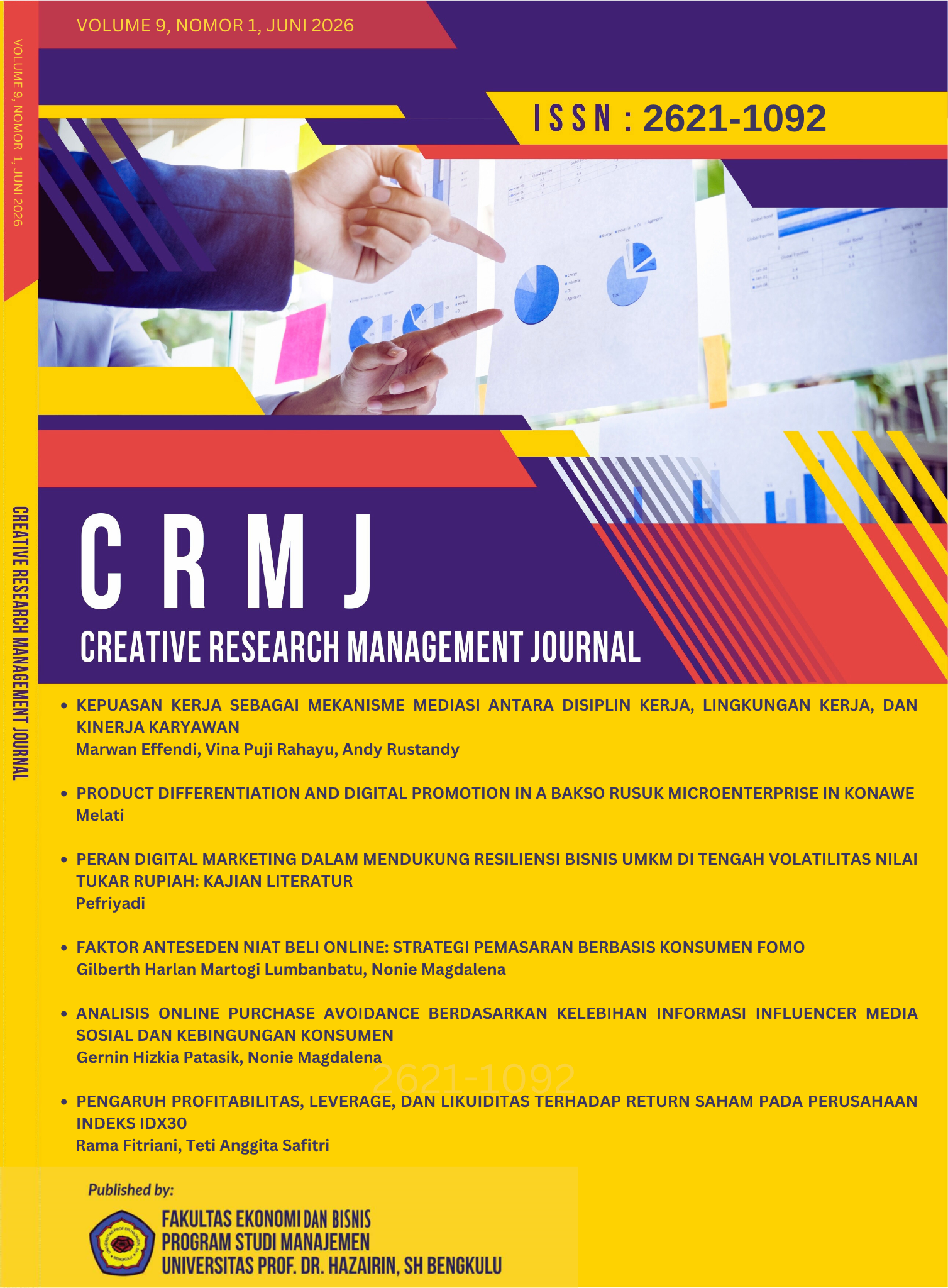
FAKTOR ANTESEDEN NIAT BELI ONLINE: STRATEGI PEMASARAN BERBASIS KONSUMEN FOMO
DOI:
https://doi.org/10.32663/dcxcvv13Kata Kunci:
Social Media Marketing Activities, Perceived Product Quality, Social Connectedness, Online Purchase Intention of FOMO-Driven ConsumersAbstrak
The growing popularity of viral products has positioned consumers with high levels of Fear of Missing Out (FOMO) as a primary target of digital marketing strategies. This study examines the effects of social media marketing activities, perceived product quality, and social connectedness on the online purchase intention of FOMO-driven consumers. Data were collected from 174 Generation Z social media users with high FOMO buying power through purposive sampling. A structured questionnaire was administered via Google Forms, and the data were analyzed using multiple linear regression with SPSS 29. The findings reveal that social media marketing activities and social connectedness exert significant negative effects on the online purchase intention of FOMO-driven consumers, whereas perceived product quality has a significant positive effect on their online purchase intention.
Referensi
Agnihotri, D., Chaturvedi, P., & Tripathi, V. (2025). The impact of social media influencer information overload on purchase avoidance: the role of customer confusion and prior product knowledge. Journal of Research in Interactive Marketing, 19(6), 897–916. https://doi.org/10.1108/JRIM-12-2023-0454.
Anastasiei, B., & Dospinescu, O. (2025). Beyond Credibility: Understanding the Mediators Between Electronic Word-of-Mouth and Purchase Intention Introduction and Hypotheses Development. https://doi.org/https://doi.org/10.48550/arXiv.2504.05359.
Ardianti, T., & Sofyan, J. F. (2024). The Influence of Ewom and Fear of Missing Out in the Intention to Buy Skincare Products Through Tiktok. Jurnal Indonesia Sosial Teknologi, 5(5). http://jist.publikasiindonesia.id/.
Badawi, B., Nurudin, A., & Muafi, M. (2021). Consumer Conformity, Social Ties and EWOM in Digital Marketing. Ingenierie Des Systemes d’Information, 26(6), 569–576. https://doi.org/10.18280/isi.260607.
Bayu Wardhana. (2024). Penjualan Produk F&B di E-commerce Meningkat 75% Jelang Ramadhan. Compas Market Insight.
Bergkvist, L., & Rossiter, J. R. (2007). The predictive validity of multiple-item versus single-item measures of the same constructs. Journal of Marketing Research, 44(2), 175–184. https://doi.org/10.1509/jmkr.44.2.175
Buglass, S. L., Binder, J. F., Betts, L. R., & Underwood, J. D. M. (2017). Motivators of Online Vulnerability: The Impact of Social Network Site Use and FOMO.
Bullock, L., & Agbaimoni, O. (2013.). Social Media Marketing – why businesses need to use it and how (includes a study of Facebook). https://doi.org/http://dx.doi.org/10.14611/minib.08.02.2013.13.
Chaubey, D. S., Sharma, L. S., & Subramanian, K. R. (2023). Social Network Marketing and its Influence on Online Purchase of Grocery Products during Covid-19 Pandemic: Mediating Role of Brand Awareness. International Journal of Electronic Commerce Studies, 13(4), 39–60. https://doi.org/10.7903/ijecs.2056.
Evita, N., Prestianta, A. M., & Asmarantika, R. A. (2023). Patterns of media and social media use in generation z in Indonesia. Jurnal Studi Komunikasi (Indonesian Journal of Communications Studies), 7(1), 195–214. https://doi.org/10.25139/jsk.v7i1.5230.
Goel, I. (2025). Fear of missing out and ephemeral social media marketing: exploring consumer engagement and purchase intention. 32(S7), 2025. Retrieved https://www.tpmap.org/
Hair Jr., J. F., Gabriel, M. L. D. da S., & Patel, V. K. (2014). Modelagem de Equações Estruturais Baseada em Covariância (CB-SEM) com o AMOS: Orientações sobre a sua aplicação como uma Ferramenta de Pesquisa de Marketing. Revista Brasileira de Marketing, 13(2), 44–55. https://doi.org/10.5585/remark.v13i2.2718
Hedges, K. "Do you have FOMO: Fear of missing out? Forbes." 2014.
Hodkinson, C. (2019). ‘Fear of Missing Out’ (FOMO) marketing appeals: A conceptual model. Journal of Marketing Communications, 25(1), 65–88. https://doi.org/10.1080/13527266.2016.1234504.
Intan Andini. (2024). Tren FMCG di E-Commerce 2024: Strategi Pricing, Performa Marketplace, dan Peluang bagi Brand. Compas Market Insight.
Jorie, Rotinsulu Jopie, Silvya L. Mandey, and Marchelyno Sundalangi. "Kualitas produk, daya tarik iklan, dan potongan harga terhadap minat beli konsumen pada Pizza Hut Manado." Jurnal Riset Ekonomi, Manajemen, Bisnis Dan Akuntansi 2.1 (2014): 2025.
Kardes, F. R. Cronley, M. L. & Cline, T. W. (2011). Consumer behavior. South-Western, Cengage Learning.
Kim, A. J., & Ko, E. (2012). Do social media marketing activities enhance customer equity? An empirical study of luxury fashion brand. Journal of Business Research, 65(10),1480–1486. https://doi.org/10.1016/j.jbusres.2011.10.014.
Knief, U., & Forstmeier, W. (n.d.). Violating the normality assumption may be the lesser of two evils. https://doi.org/10.3758/s13428-021-01587-5/Published.
Kotler, Philip, Kevin Lane Keller, and Alexander Chernev. Marketing management, global edition. Vol. 832. Pearson, 2022.
Lee, R. M., & Robbins, S. B. (1995). Measuring Belongingness: The Social Connectedness and the Social Assurance Scales. In Journal of Counseling Psychology (Vol. 42, Issue 2).
Liu, Y., & Ahmad, Mohd. K. (2026). Digital Stress and Psychological Outcomes in Digital Natives and Digital Immigrants: A Systematic Literature Review. Journal of Intercultural Communication, 26(1), 1–18. https://doi.org/10.36923/jicc.v26i1.1202.
Lou, C., Taylor, C. R., & Zhou, X. (2023). Influencer Marketing on Social Media: How Different Social Media Platforms Afford Influencer–Follower Relation and Drive Advertising Effectiveness. Journal of Current Issues and Research in Advertising, 44(1), 60–87. https://doi.org/10.1080/10641734.2022.2124471.
Luhgiatno (2024). Metode Penelitian manajemen. Penerbit CV. Eureka Media Aksara.
Ma, L., Zhang, X., Ding, X., & Wang, G. (2021). How social ties influence customers’ involvement and Online purchase intentions. Journal of Theoretical and Applied Electronic Commerce Research, 16(3), 395–408. https://doi.org/10.3390/jtaer16030025.
Mat Nawi, F. A., Abdul Malek A.Tambi, Muhammad Faizal Samat, & Wan Masnieza Wan Mustapha. (2020). A review on the internal consistency of a scale: the empirical example of the influence of human capital investment on malcom baldridge quality principles in tvet institutions. Asian People Journal (APJ), 3(1), 19–29. https://doi.org/10.37231/apj.2020.3.1.121
Meliawati, T., Gerald, S. C., & Akhmad Edhy Aruman. (2023). The Effect of Social Media Marketing TikTok and Product Quality Towards Purchase Intention. Journal of Consumer Sciences, 8(1),77–92. https://doi.org/10.29244/jcs.8.1.77-92.
Mehrabian, A., & Russell, J. A. (1974). The Basic Emotional Impact of Environments. Perceptual and Motor Skills, 38(1), 283–301. https://doi.org/10.2466/pms.1974.38.1.283
Mohammed, A. A. A., Osman, M. M., Ali, M. M. M., Adam, M. O., Mustafa, M. E. E., Babikir, A. M., Abdulsamad, A. M. I., Abo, M. E. A., Yasein, Y. A. M., Abdelgader, M. S. S., Hasabo, E. A., & Ibrahim, M. E. (2023). Social networking and fear of missing out (FOMO) among medical students at University of Khartoum, Sudan 2021. BMC Psychology, 11(1). https://doi.org/10.1186/s40359-023-01403-z.
Pham, P. H. M., & Gammoh, B. S. (2015). His research has appeared in the European Journal of Marketing. In Journal of Personal Selling and Sales Management (Vol. 9, Issue 4).
Przybylski, A. K., Murayama, K., Dehaan, C. R., & Gladwell, V. (2013). Motivational, emotional, and behavioral correlates of fear of missing out. Computers in Human Behavior, 29(4), 1841–1848. https://doi.org/10.1016/j.chb.2013.02.014.
Punjani, K. K., Kumar, V. V. R., & Mahadevan, K. (2024). Impact of advertising puffery on purchase intention and brand loyalty of young adults. International Journal of Consumer Studies, 48(3). https://doi.org/10.1111/ijcs.13045.
Roberts, J. A., & David, M. E. (2020). The Social Media Party: Fear of Missing Out (FOMO), Social Media Intensity, Connection, and Well-Being. International Journal of Human-Computer Interaction, 36(4), 386–392. https://doi.org/10.1080/10447318.2019.16465 17.
Siddiqui, M. S., Siddiqui, U. A., Khan, M. A., Alkandi, I. G., Saxena, A. K., & Siddiqui, J. H. (2021). Creating electronic word of mouth credibility through social networking sites and determining its impact on brand image and Online purchase intentions in India. Journal of Theoretical and Applied Electronic Commerce Research, 16(4), 1008–1024. https://doi.org/10.3390/jtaer16040057.
Sinha, S., Siddiqui, U. A., & Khare, A. K. (2025). Decoding Viral Marketing: A Structural Equation Modelling Approach to Investigate the Factors Affecting Consumer Purchase Intention. In Advances in Consumer Research (Vol. 2, Issue 4).
Spiteri Cornish, L. (2020). Why did I buy this? Consumers’ post-impulse-consumption experience and its impact on the propensity for future impulse buying behaviour. Journal of Consumer Behaviour, 19(1), 36–46. https://doi.org/10.1002/cb.1792
Syafika Mumtaz, Z. (2021). Pengaruh penggunaan aplikasi tik tok sebagai media promosi dan trend glow up terhadap minat beli produk kecantikan. 13(2), 282–291. https://bit.ly/Generasilanggasterkoneksi
Yadav, M., & Rahman, Z. (2017). Social media marketing: literature review and future research directions. In Int. J. Business Information Systems (Vol. 25, Issue 2). https://doi.org/https://doi.org/10.1504/IJBIS.2017.083687.
Zhang, Z., Jiménez, F. R., & Cicala, J. E. (2020). Fear Of Missing Out Scale: A self-concept perspective. Psychology and Marketing, 37(11), 1619–1634. https://doi.org/10.1002/mar.21406.
Unduhan
Diterbitkan
Terbitan
Bagian
Lisensi
Hak Cipta (c) 2026 Gilberth Harlan Martogi Lumbanbatu, Nonie Magdalena

Artikel ini berlisensi Creative Commons Attribution 4.0 International License.