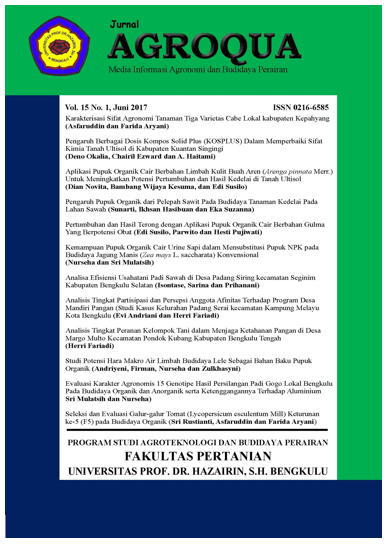
EVALUASI KARAKTER AGRONOMI 14 VARIETAS PADI GOGO LOKAL BENGKULU
DOI:
https://doi.org/10.32663/ja.v23i2.5294Keywords:
agronomic, characteristics, evaluation, local upland rice, varietiesAbstract
The study aimed to determine the agronomic characteristics of 14 local upland rice varieties from Bengkulu. The study used a randomized block design (RBD) with one factor, namely 14 local upland rice varieties, and six replications. It's varieties was G1; Keleng Mano, G2; Masak Berangin, G3; Tambun Buih, G4; Sebakas, G5; Ogan, G6; Siung Kancil, G7; Sirantau, G8; Abang Pintal, G9; Babatan, G10; Komering, G11; Lampung, G12; Ir 64, G13; Sawah Darat, and G14; Umbul-umbul. The results concluded that there is agronomic diversity among the 14 local upland rice varieties from Bengkulu. The highest plant height ranged between 131 – 152 cm and was not significantly different shown in the varieties of Ogan 146.83 cm, Sirantau, Keleng Mano, Masak Berangin, Siung Kancil, Tambun Buih, Abang Pintal, Babatan, Sebakas, Komering, Lampung respectively and the lowest plant height ranged between 88 - 96 cm in the Sawah Darat, Umbul-umbul and IR 64 varieties with a height of 87.87 cm. The highest total number of tillers ranged between 15.5 – 18.5 tillers in the Sirantau variety but was not significantly different from the varieties of Ogan, Siung Kancil, IR 64, Tambun buih, Sebakas, Babatan and Lampung while the lowest number of tillers was in the Sawah Darat variety. The highest number of productive tillers ranged from 7.5 to 9.5 for the Sirantau, Komering, Ogan, Siung Kancil, IR 64, Sebakas, Tambun Buih, Lampung, Babatan, and Abang Pintal varieties. The lowest number of productive tillers ranged from 6.3 to 6.8 for the Masak Angin, Sawah Darat, Umbul-umbul, and Keleng Mano varieties. The fastest flowering time ranged from 78 to 90 days and was not significantly different for the IR 64, Umbul-umbul, Komering Lampung, and Sawah Darat varieties.
References
Anonim, (2016). Luas panen dan produksi tanaman pangan dan hortikultura di provinsi Bengkulu. Dinas Pertanian Tanaman Pangan dan Hortikultura Provinsi Bengkulu.
Asfaruddin, (2008). Eksplorasi dan karakterisasi padi gogo lokal di Bengkulu. Jurnal Agroqua 2(2), 13-22.
Asfaruddin, (2012). Evaluasi ketenggangan galur-galur padi gogo terhadap keracuan alumunium dan efisiensinya dalam penggunaan kalium. Jurnal Agroqua 5(2). 19-25
Asfaruddin dan Mulatsih, S. (2017). Evaluasi toleransi 32 genotipe hasil persilangan padi gogo lokal Bengkulu terhadap naungan pada kebun kelapa sawit muda. Agroqua 15(2), 21-28
Badan Pusat Statistik. (2009). Statistik Indonesia Badan Statistik Indonesia. Jakarta.
Diptaningsari, (2013). Analisis keragaman kartakter agronomis dan stabilitas galur harapan padi gogo turunan padi lokal Pulau Buru hasil kultur antera. (Disertasi). Program Pasca Sarjana, Institut Pertanian Bogor. Bogor.
International Rice Research Institute. (2012). Rice Standard Evaluation System. https;//www.knowledgebank.irri.org/extention/crop-damage.
Mulyana, D.,Sakhidin, dan A. Iqbal. (2011). Pengaruh dosis bokashi terhadap pertumbuhan dan hasil tiga varietas padi. Jurnal Agrin. 15(2), 18-26.
Silitonga, T.S.(2012). Ekploration, and collection for wild rice species in Irian Jaya. Buletin Plasma Nutfah, 8(1), 9-12
Sri Mulatsih, S. Dan Nurseha. (2017). Evaluasi karakter agronomis 15 genotipe hasil persilangan padi gogo lokal Bengkulu pada budidaya organik dan anorganik serta ketenggangannya terhadap Alumunium, Agroqua 15(1), 76 – 82.
Suradi, Luthy, K. Yenni, dan Gunawan. (2012). Evaluasi karakter pertumbuhan dan hasil 17 genotipe plasma nutfah padi. Buletin Plasma Nutfah. 18(1), 31-37.
Soerjandono, N. B, dan Robi’in, (2012). Teknik pengujian galur harapan padi gogo. Buletin Teknik Pertanian, 17(1),7-9.
Yudarwati, (2010). Analisis faktor fisik yang mempengaruhi produktivitas padi sawah dengan aplikasi sistem informasi geografis. (Disertasi). Program Pasca Sarjana, Institut Pertanian Bogor. Bogor.
Downloads
Published
Issue
Section
License
Copyright (c) 2025 Sri Mulatsih, Asfaruddin

This work is licensed under a Creative Commons Attribution 4.0 International License.
Authors who publish with this journal agree to the following terms:
- Authors grant the journal right of first publication with the work simultaneously licensed under a Creative Commons Attribution 4.0 Internasional (CC BY 4.0) Licence that allows others to use and share the work with an acknowledgment of the work's authorship and initial publication in this journal.
- The author(s) still hold the copyright of his/her/their work and retain publishing rights without restrictions such as (but not limited to) patent right, lecture, book and reproduce the article for own purposes.