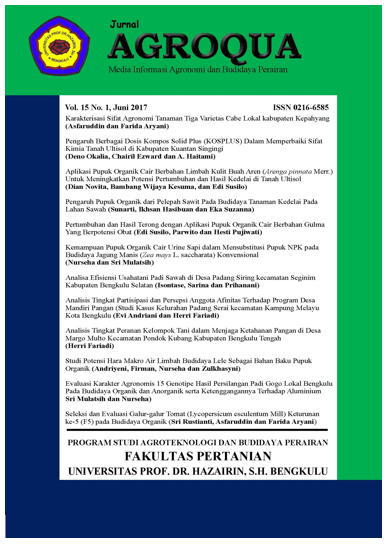
Karakteristik Agronomis 10 Galur Tanaman Tomat Hasil Persilanggan Pada Budidaya Organik
DOI:
https://doi.org/10.32663/ja.v24i1.5441Keywords:
breeding lines, organic cultivation, tomato, yield performanceAbstract
This study aimed to evaluate the agronomic performance of ten tomato breeding lines under an organic cultivation system and to identify potential lines for further development. The experiment was conducted from March to July 2025 in Bengkulu, Indonesia, using a Completely Randomized Design (CRD) with ten tomato breeding lines and three replications. The tested lines were G3, G4, G5, G6, G7, G9, G12, G13, G15, and G16. Each experimental unit consisted of three plants, resulting in a total of 90 plants. Organic cultivation practices included the application of goat manure, fermented liquid organic fertilizer, and botanical pesticides derived from garlic extract. Observed variables included vegetative growth, reproductive traits, and yield components. Data were analyzed using analysis of variance (ANOVA), followed by Duncan’s Multiple Range Test (DMRT) at the 5% level when significant differences occurred. The results showed that the tested tomato breeding lines did not differ significantly in plant height, leaf number, branch number, stem diameter, flowering age, harvesting age, flower number, fruit number, fruit weight, and fruit diameter. However, descriptive evaluation indicated that G12 and G15 consistently produced higher flower number, fruit number, and fruit weight than the other lines. These findings suggest that all tested lines exhibited relatively stable adaptation under organic cultivation conditions, while G12 and G15 showed greater potential for further multilocation evaluation and organic tomato breeding programs.
References
BPS, (2024). Statistik Tanaman Hortikultura Indonesia. Badan Pusat Statistik Indonesia
Damayanti, F., Astri, A., Anas, Sari, S., Bakti, C. (2024). Evaluasi kualitas buah, komponen hasil dan hasil enam varietas tomat calon tetua persilangan. J. Agrikultura, 35(3), 413-425. doi: https://doi.org/10.24198/agrikultura.v35i3.49852
Gliessman, S. R. (2015). Agroecology: The Ecology of Sustainable Food Systems. CRC Press.
Jones, J. B. (2007). Tomato Plant Culture: In the Field, Greenhouse, and Home Garden. CRC Press.
Peet, M. M. (2005). Environmental stress and developmental disorders in tomato fruit. Journal of Horticultural Science & Biotechnology, 80(6), 9-19.
Peralta, I. E., Spooner, D. M., & Knapp, S. (2008). Taxonomy of wild tomatoes and their relatives (Solanum sect. Lycopersicoides, sect. Juglandifolia, and sect. Lycopersicon - Solanaceae). Systematic Botany Monographs, 84, 1–186.
Reganold, J. P., & Wachter, J. M. (2016). Organic agriculture in the twenty-first century. Nature Plants, 2, 15221. https://doi.org/10.1038/nplants.2015.22
Rustianti, S., Asfaruddin dan Aryani, F. (2017). Seleksi dan evaluasi galur-galur tomat (Lycopersicum esculentum Mill.) keturunan ke-5 (F5) pada budidaya organik. J. Agroqua, 15(1), 90-102.
Singh, B. D., et al. (2020). Selection of tomato breeding lines for organic farming systems. Journal of Agricultural Research, 58(4), 123–135.
Taylor, I. B. (Ed.). (1986). The Tomato Crop: A Scientific Basis for Improvement. Chapman & Hall.
Downloads
Published
Issue
Section
License
Copyright (c) 2026 Sri Rustianti, Sri Mulatsih, Duni Sahputra, Prihanani

This work is licensed under a Creative Commons Attribution 4.0 International License.
Authors who publish with this journal agree to the following terms:
- Authors grant the journal right of first publication with the work simultaneously licensed under a Creative Commons Attribution 4.0 Internasional (CC BY 4.0) Licence that allows others to use and share the work with an acknowledgment of the work's authorship and initial publication in this journal.
- The author(s) still hold the copyright of his/her/their work and retain publishing rights without restrictions such as (but not limited to) patent right, lecture, book and reproduce the article for own purposes.