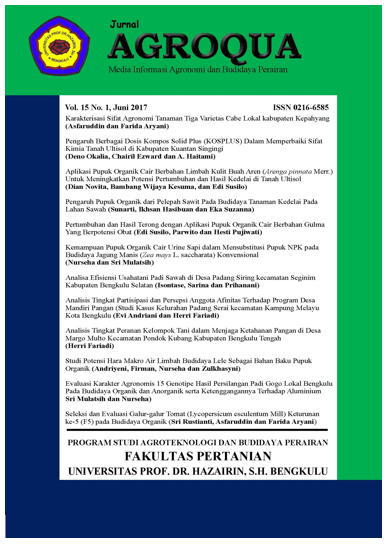
Efektivitas Rumpon Sebagai Struktur Habitat Dalam Menekan Kanibalisme Pada Benih Ikan Baung (Mystus nemurus) Di Kolam Bulat
DOI:
https://doi.org/10.32663/ja.v24i1.5456Keywords:
Baung fish, habitat complexity, cannibalism, rumpon, survival rateAbstract
This study investigated the effectiveness of artificial shelter structures (rumpon) in reducing cannibalism and improving the survival rate of baung fish (Mystus nemurus) fry cultured in circular ponds. Cannibalism is one of the major constraints in baung fish hatchery production because it significantly decreases fry survival and productivity. A Completely Randomized Design (CRD) consisting of four treatments, namely control (without rumpon), full rumpon, ¾ rumpon, and ½ rumpon, with three replications for each treatment was applied. Parameters observed included survival rate and water quality (temperature, pH, and dissolved oxygen). Data were analyzed using analysis of variance (ANOVA), while water quality parameters were analyzed descriptively. The results showed that the full rumpon treatment produced the highest survival rate (56%), followed by ½ rumpon (50%), ¾ rumpon (45%), and control (13%). The presence of rumpon increased habitat complexity, reduced direct interactions among fry, minimized cannibalistic behavior, and consequently improved survival. This study demonstrates that coconut leaf rumpon can serve as a simple, environmentally friendly, and low-cost habitat modification technology to enhance baung fish hatchery performance.
References
Baras, Etienne, and Malcolm Jobling. (2002. )Dynamics of intracohort cannibalism in cultured fish. Aquaculture Research 33(7), 461–79.
Begon, Michael, Colin R Townsend, and John L Harper. 2006. Ecology: From Individuals to Ecosystems. 4th ed. Oxford, UK: Blackwell Publishing.
Dempster, T, and M Taquet. 2004. Fish aggregation device (FAD) research: gaps in current knowledge and future directions for ecological studies. Reviews in Fish Biology and Fisheries 14(1), 21–42.
Edeline, Eric, and others. (2025).Habitat structural complexity increases age-class coexistence and population growth by relaxing cannibalism. Peer Community Journal.
Effendie, M I. (1997.) Biologi Perikanan. Yogyakarta: Yayasan Pustaka Nusatama.
Hecht, T, and A G Pienaar. (1993). A review of cannibalism and its implications in fish larviculture Journal of the World Aquaculture Society 24(2), 246–61.
Huntingford, Felicity A et al. 2006. Current Issues in Fish Welfare. Oxford, UK: Blackwell Publishing.
Kottelat, Maurice, Anthony J Whitten, Sri Nurani Kartikasari, and Soetikno Wirjoatmodjo. (1993). Freshwater Fishes of Western Indonesia and Sulawesi. Hong Kong: Periplus Editions.
Mercader, M, and others. (2019). Is artificial habitat diversity a key to restoring nurseries for juvenile coastal fish? ex situ experiments on habitat selection and survival of juvenile seabreams.” Restoration Ecology 27(5), 1155–65.
Savino, Jacqueline F, and Roy A Stein. (1982). Predator-prey interaction between largemouth bass and bluegills as influenced by simulated, submersed vegetation. Transactions of the American Fisheries Society 111(3), 255–66.
Silitonga, Inda Feriwanti, Nuraini, and Sukendi. (2022.) Pengaruh pemberian oodev (oocyte developer) dengan dosis yang berbeda terhadap kematangan gonad dan penetasan telur ikan baung (Hemibagrus nemurus). Jurnal Akuakultur Sebatin 3(1), 114–24.
Subani, W, and H R Barus. (1989). Alat Penangkapan Ikan Dan Udang Laut Di Indonesia. Jakarta: Balai Penelitian Perikanan Laut, Badan Penelitian dan Pengembangan Pertanian.
Sudiyatno, Sudiyatno, and Armen Nainggolan. (2021). Analisis padat penebaran terhadap pertumbuhan benih bawal bintang (Trachinotus blochii) di keramba jaring apung, PT. Nuansa Ayu Karamba, Pulau Pramuka, Kab. Adm. Kepulauan Seribu, DKI Jakarta. Jurnal Ilmiah Satya Minabahari 6(2): 106–15.
Downloads
Published
Issue
Section
License
Copyright (c) 2026 Sri Murtini, Kadek Adi Suwandana, Neksidin, Selviana Anggraini, Mahadi Suroso

This work is licensed under a Creative Commons Attribution 4.0 International License.
Authors who publish with this journal agree to the following terms:
- Authors grant the journal right of first publication with the work simultaneously licensed under a Creative Commons Attribution 4.0 Internasional (CC BY 4.0) Licence that allows others to use and share the work with an acknowledgment of the work's authorship and initial publication in this journal.
- The author(s) still hold the copyright of his/her/their work and retain publishing rights without restrictions such as (but not limited to) patent right, lecture, book and reproduce the article for own purposes.