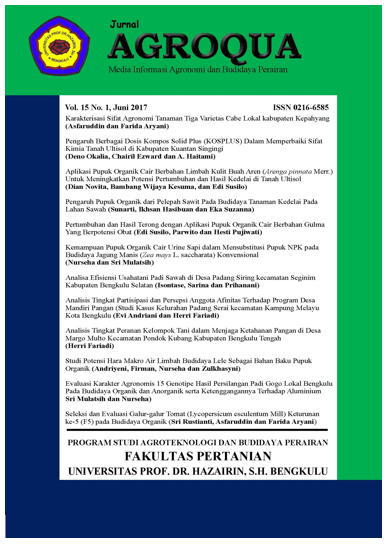
VARIABILITAS GENETIK SIFAT MUTU BIBIT KOPI ARABIKA DATARAN TINGGI BENGKULU
DOI:
https://doi.org/10.32663/ja.v21i1.3632Keywords:
coffee arabika, highland, genetic variabilityAbstract
Increasing Arabica coffee production must start with the provision of quality, affordable and available seeds in sufficient quantities. Breeding programs generally start with establishing a basic population. Populations can be formed from germplasm that have diverse genetic makeup in an effort to assemble genetic diversity into a new type that has advantages over pre-existing types, so that in cultivating a plant commodity genetic variability or diversity is the main requirement so that breeding goals can be achieved. achieved. The purpose of this study was to inventory and determine genetic diversity in the quality traits of Bengkulu highland arabica coffee seedlings. The research was carried out from June to December 2022 in Rejang Lebong Regency. The research design used a Completely Randomized Block Design (RAKL) with the treatment of Arabica coffee genotypes from inventory (G) with 4 replications. Each genotype will be planted 10 seeds per repetition, so that each genotype is 40 seeds. Data analysis was performed using analysis of variance and estimation of the variance value. The results of the Arabica coffee inventory in this study were Bourbon, Cattura Red, Cattura Yellow, S-1934, Andungsari, M-97, M-98, Sigararutang, Kartika and USDA 230762. Genetic Variability (Kvg) narrow criteria values ??were found in almost all variables observations were on the characteristics of plant height, stem diameter, seed sturdiness, leaf greenness, stomata density, leaf weight, total dry weight, shoot dry weight, root dry weight, shoot root ratio, and seed quality index, while the Kvg value with area criteria was in find in variable a pair of leaves.
References
Downloads
Published
Issue
Section
License
Authors who publish with this journal agree to the following terms:
- Authors grant the journal right of first publication with the work simultaneously licensed under a Creative Commons Attribution 4.0 Internasional (CC BY 4.0) Licence that allows others to use and share the work with an acknowledgment of the work's authorship and initial publication in this journal.
- The author(s) still hold the copyright of his/her/their work and retain publishing rights without restrictions such as (but not limited to) patent right, lecture, book and reproduce the article for own purposes.